Sabado, Disyembre 12, 2015

Speeding up? Naah, just enjoy it.

High school gave me experiences that are worth the keep in my wooden treasure box. But to be frank, during those four years in high school waking up 5am in the morning, waiting for a motor (a motorcycle with a sidecar and a roof; our city’s mode of transportation), arriving before the 7:20 am flag ceremony, chitchatting about wattpad-stories, clash of clans, how the weekend was or the latest school gossip somehow became normal to me. Even those mornings when some are reviewing for the math quiz or the boys coping up with their unfinished essays that were due on the afternoon became a usual vista to the eye and we, humans have that orientation that when we became accustomed with things by some means, we struggle to see the significance of it. And I’m not an exception.

I always wanted time to speed up back in my senior year and I was caught up in my eagerness to enter college and so, I attach a sparse importance to occurrences in my last year in high school. As graduation day took place and I and my other forty-one batch mates finally worn our white togas with blue cord around the shoulder and tassels flipped at the left, we stood in three lines arrange according to our height in front of the altar, facing our families, friends and teachers. We stood there with our medals, ribbons and pins; we stood there to sing our graduation and batch song, and for the last time, we stood there to sing our Alma Matter song the “Stella Maris Hymn”.


As we heard the G minor, as our cue, in unison we put down our graduation caps and place it near our chest. The pianist started to play the keys and the whole Holy Rosary Parish was filled with the melody of the song “Time of our lives” by Tyrone Wells and as the intro fades, we sang our hearts out.

 This is where the chapter ends
And new one now begins
Time has come for letting go
The hardest part is when you know
All of there years
When we were here
Are ending 
But I'll always remember


And for a moment, I saw in a swift stride flashes of vivid time of events in my four years in high school. I even saw snippet of moments during my first day in freshmen year, the new faces, the introduce-yourself-in-front, the welcome to the family event organized by the student council to welcome the freshmen, transferees and new staffs and I remember in a picturesque our first and last educational field trip in Rizal Shine at Dapitan City.

I remember the chaotic scene where everyone's voice filled the bus with their excitement; others are busy eating the chips they bought, some folks were standing; others were chatting with their seatmates and of course, some were taking pictures.


Arriving at the destination, I recall listening to a symposium about the life and works of our national hero, Dr. Jose Rizal and after, we were able to roam around the premises which not only holds historical ambience but as well as a precise illustration of nature. You could feel the cool and fresh air around; you could also see flowers and trees at every corner and a pond at one side. There were also a lot of kubo around the area and some of these are:


Casa Redonda is a house with eight sides which was Rizal’s clinic. The step-father of Josephine Bracken, George Taufer had his eye operated in Casa Redonda.


Casa de Salud or the health houses are two small huts (one for male and one for female) roost onto a low hill which was intended for Rizal’s out-of-town patients.


Casa Residencia is the main house and also the biggest one. This is where Rizal lived during his exile at Dapitan with his girlfriend, Josephine Bracken. I somehow remember seeing a photo of Rizal inside the house.


At the end of the shrine, a gargantuan rock could surely catch your attention. This enormous rock is called “Mi Retiro Rock” or Rizal’s retreat rock. While sitting on the rock, Rizal wrote the first few stanzas of the poem “Mi Retiro” hence, the name.  Jose Rizal and Josephine Bracken (Rizal’s girlfriend) has spent many romantic moments on the rock as well but what amaze me more of this rock is its exquisite view of the Sulu Sea.
The view on top of the Mi Retiro Rock

I couldn’t remember more of the adventure but as those images flick in my head, I feel like I want to go back to those moments, enjoy the scenery, took more pictures, remember the jokes behind the laughs, and just seize the moment.  I felt the feeling of going back and re-experience it again so that when I choose to turn the page in my freshmen year, I have something to write about, I have something I could vividly remember during my first year in high school.

We have had the time of our lives
And now the page is turned
The stories we will write
We have had the time of our lives
And I will not forget the faces left behind
It’s hard to walk away from the best of days
But if it has to end, I’m glad you have been my friend
                                                               In the time of our lives 

In front of the altar, we stood facing our loved ones and sang, yet I somehow felt like we were not just singing the song, we were feeling it.We just didn’t sing with the rhyme but we became one with the rhythm, we weren’t just saying the words but we relate to the words and that is what feeling a song is.  As everyone continued to sing, I heard voices but at the same time I also heard sobs and faint cries. Some of my batch mates started being emotional and so did I.

Actually, most of my batch mates in high school were also my batch mates in elementary. I spend ten years with these people starting from learning the ABAKADA, the odd and even and the is and are to knowing Jose Rizal, finding the x of the slope and computing the gross domestic income of the nation. I grow up with these people and became too familiar with them to the extent that we could distinguished ones hand writing, know who could eat four cups of rice, whose the procrastinators or even joke with ones drawing. Four or ten years are a long time and in this span of time we’ve created memories. One exciting moment in high school that I was able to spend with my batch mates was the Junior-Senior Promenade. Who could ever forget their first prom?


Our promenade was simple, it didn’t take place in a lavish three-star hotel nor had an overrated theme. We held our promenade at our school’s Quonset Hall with a theme “Children of the Past, Stewards of the World Today: Building a Nation of Love for the Future.” 


Inside the hall, chairs covered with white cloth and a stripe of blue at the top were placed at the right side intended for us, juniors and at the left side, chairs with red stripe were intended for the seniors. A red carpet was placed at the aisle and at the corner were white anthuriums and an artificial cherry blossom. The stage was also decorated with a pink and blue motif, a table was place at the centre of the stage then above it where roses and candles, in front of the table were two big candles and at the side was the emcee’s table.


The program was divided in three parts; the first part was a paraliturgy. The first part begun with students in pair (a junior and a senior) entered the hall, followed by an opening prayer then the presentation of the symbols: the key of responsibility, the school logo, rosaries and candles which will be used for the highlight of the first part, the turning over of the key of responsibility. 


The turning over of the key of responsibility was a symbolic hand over. The seniors led with the supreme student council president of that time, Gianne Uy Guantero passed on the key of responsibility which symbolized being a sensible and reliable ates and kuyas to the lower years and the running student council candidates, I and Althea Jane B. Molina accepted the key on behalf of all juniors. On our counterpart, we juniors handed over our school logo to our seniors for them to be reminded of our school’s vision and mission as they step out of the walls of our school and live the teachings of mother Mary of the Passion and St. Francis of Assisi as they ventured to another chapter in their lives, college. 

The second part of the program was dinner and the last part was the fun part of it all, the party time. Everyone changed from their uniforms to semi-formal dresses, we just dance, sing and party all night long and we didn’t realize we were already making memories we could keep. 

Where the water meets the land
There is shifting in the sand
Like the tide that ebbs and flows
Memories will come and go
All of these years
When we were here
Are ending, but I’ll always remember…
We say goodbye, we hold on tight
To these memories that never die.

I see flashes of cameras while we were singing. Our parents are in front watching us as we fulfilled another chapter, as we say goodbye and as we turn this moment into a memory. I look further and beyond the massive door of the church, I saw a glimpse of the open field and I recall that day, January 26, 2015, three am in the morning.

Before the cramming and burning of candles for the final exams, before the anxiety of knowing the results of the deliberation of honors and before the repetitive practice for the graduation day, all of us fourth year students, indulge first with the thought of going to Josefina, Zamboanga del Sur. During senior year, one of the most awaited experience is the three days and two nights retreat in Josefina, the fourth year before us shared how beautiful the place and how memorable there stay was and our batch was looking forward of visiting the place and so, the day itself arrived.  


 The call time was three am in the morning but due to over excitement, most of us slept late the night before and even those who spent the night in one of my classmate’s house didn’t slept at all! And that was the reason why some were late. We were able to leave the school ground around five am in the morning. 


The travel from Oroquieta City to Josefina is four hours
 and so, for the whole trip we prayed all the mysteries 
of the rosary, after that some decided to sleep and others decided to eat and just enjoyed the golden beam of 
light from the crack of dawn cascading throughout
 the vast horizon outside the car’s window pane.


Around nine am in the morning we arrived at the Inter-Franciscan Retreat House where we will be staying for next three days. The place is on top of a mountain thus giving us beautiful scenery and a perfect view of nature, there were a lot of trees around the convent and because it is in a high plane, the breeze is cold and every morning you could expect fog.


The place is outstanding; you could feel at ease, tranquil, balance and harmonious. What the place could offer is far from the buzzing city state, the sound of the birds can soothe your body, mind and spirit, the whoosh of the leaves in a light breeze brings you tranquility and the sound of crickets at night could be your serene lullaby.


When we arrived, the first thing we did was of course, take pictures.


After a while, we place our things in the assign rooms for us. The dormitories for girls and for boys are in separate building but still in the same compound. Inside the dormitory, each room can accommodate four persons and have two double deck beds and at the left end of the quarter, you could find the comfort rooms.

After we had our breakfast, our phones where surrendered so that it could not alter the purpose of the retreat and afterwards we proceeded with the schedule. Sister Isabelita P. Suarez, FMM our school directress held a talk about life’s treasures and how these treasures are more important than the earthly ones. We consumed the first day talking and sharing about this topic. The following day, we talked about that one lady in our life that will always be selfless for us, our mother and in the afternoon, we had a confession.


During the last day, we woke up around four am to attend a mass at the poor Claire’s monastery. It was still so dark while we walked to the church; we could barely see the pavement. It was also cold that you could shiver and feel the coldness tingle your bone. After hearing the mass and the day break, we visited and talked with the poor Claire nuns.


Heading back to the retreat house, we’ve been amaze again of the beauty this place hold. Just a few steps away from the church, you could see a towering sculpture of the sacred heart of Jesus and below it were flowers forming the word “JESUS”. 

And of course, we don’t want to regret not having a picture in the place and so, snap!


We have had the time of our lives
And now the page is turned
The stories we will write
We have had the time of our lives
And I will not forget the faces left behind
It’s hard to walk away from the best of days
But if it has to end, I’m glad you have been my friend
In the time of our lives
I’m glad you have been my friend
In the time of our lives

As the song ends and the melody fades, I see my batch mates’ faces in tears. We’ve finished the song, we’ve finish the ceremony, we’ve finished high school. At that moment I realize how wasteful it is to wish for time to speed up because no matter how scary, how boring or how embarrassing that time is, it will always depend on you if you’re going to change that time into a moment then five, ten or fifteen years after, you’ll look back and laugh with those memories. Leap your faith and take a chance because you’ll never know how a certain moment can turn out into a quintessential memory. Yes, a memory because when you realize the true value of a moment, then it becomes a memory that is worth the keep in your wooden treasure box.

Linggo, Nobyembre 29, 2015

Dengue: Another Horror Story

"Sobra kahadlok. Imong anak, makakita lang ka, di na nako madiscribe. Ingdako iyang tiyan, basta nagbleeding na siya nagsuka na. (It was frightening. Seeing your child like that, I can not describe the feeling. His stomach swollen, he started to bleed and vomited.) Mrs. Irma Lamparas (personal communication, November 1, 2015) stated when she told me about what happened to her son, Leo Serge B. Lamparas at the age of seven.


Serge Leo Lamparas recovering from dengue-tyhoid.
I went to Provincial Hospital to find someone to interview about dengue cases last November 1, 2015 and I was led to a private room in the second floor of the said hospital. I was able to interview Mrs. Irma Lamparas, a staff nurse at Misamis Occidental Provincial Hospital, and her son, Leo Serge B. Lamparas who was recovering from a dengue-typhoid. As Mrs. Lamparas told me about the situation of her son, she revealed to me that it was not the first time Serge Lamparas had dengue.  

"When he was seven years old gidengue man sab na siya. Four months mi sa ICU. "(When he was seven years old, he had dengue. We stayed four months in the Intensive Care Unit.) Mrs. Lamparas said. She also disclose to me Serge's situation during the first time he had dengue.

"Gi-ingnan mi sa doctor na sa 13 patients na admitted like his case, walay nabuhi. So gipadawat na sa amo, pero dili man jud ko. Mao na gi.ICU siya gi.abunohan ug dugo. Daghan kaayog dugo murag Christmas tree." (The Doctors told us that out of 13 patients admitted like his case, none survived. So, the doctor wanted me to accept it but I do not want to. He was admitted in the ICU and was transfused with a lot of blood. There were bags of blood that it looked like a Christmas tree.) Mrs. Irma Lamparas perorate.


Mrs. Irma and Serge Lamparas after my interview.


Before I ended our interview, I asked Mrs. Irma if dengue is something not to be taken easily and she answered: "Yes Gang. Grabi jud siya." (Yes, it [dengue] is parlous.)

Based on the testimony and experience of the Lamapara's, dengue is a serious disease, but before we go further, what is dengue?

World Health Organization (2009) defined dengue as a mosquito-borne viral disease and is rapidly spreading in the world. In the last 50 years, incidence has increased 30-fold with increasing geographic expansion to new countries and, in the present decade, from urban to rural settings. (P.3) Based on Frontiers in Dengue Virus (2010), Dengue virus is the causative agent of dengue fever, which is one of the most common significant emerging disease to global public health. In recent decades there has been an unprecedented increase in the geographic range, incidence, and severity of infection.

As stated by the World Health Organization (2009), an estimated 50 million cases happen yearly and roughly 2.5 billion people populate countries prone to dengue. Even the World Health Organization (WHO) wanted its member states to be committed to dengue disease for it can spread widely even outside a nation's borders if not treated or handle well.

 Dengue disease is boundless and even Asia can not elude from its menace. Based on a survey conducted by the World Health Organization (2009), 1.8 billion or more than 70% of the population with Dengue worldwide is widespread at South-East Asia Region or the Pacific Region. Eight countries namely Bangladesh, India, Indonesia, Maldives, Myanmar, Sri Lanka, Thailand and Timor-Leste announce Dengue cases. In 2004, the country's first outbreak betide at Bhutan and in 2005, Timor-Leste had a "high case-fatality rate" (3.55%).

The Philippines, as stated by the World Health Organization (2009), is one of the four countries (Cambodia, Malaysia and Vietnam) in the Pacific Region with multiple dengue cases and deaths between 2001 and 2008. The amount of dengue cases in the Philippines together with Cambodia in 2008 existed in its highest peak compared to other nations in the Pacific region. The Philippine Department of Health (DOH) reported to WHO a sum of 59,943 dengue cases from January to September of last year (2014) and 10.47% of the overall cases came from Northern Mindanao . As of this year (2015), dengue cases rise by 9.15% higher than in 2014 during the same span of time. Notwithstanding the increase number of cases, the DOH reported 168 deaths or 0.3% from January to August, which is lower than 2014 figure (217 deaths).

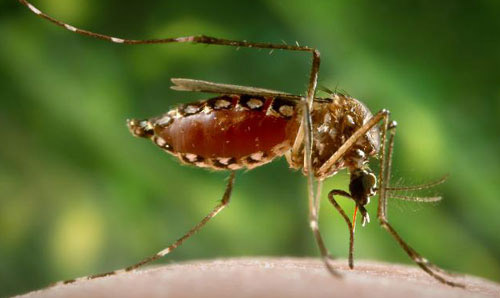
J. Gathany (Photographer). An Aedes aegypti from mosquito.Retrieved
http://entnemdept.ufl.edu/creatures/aquatic/aedes_aegypti06.jpg
The agent that disseminates the viruses that cause dengue fever is the Aedes aegypti mosquito. Through the bites of a contaminated female Aedes, the viruses are passed. The mosquitoes mainly obtain the virus while feeding on the blood of an affected person (WHO, 2015). These mosquitoes do not select its victims . According to Dr. Ismael H. Mohrein VI (Personal communication, November 1, 2015) "Fair ang distribution niya. As of now, diri sa hospital kay naa mi cases na adult naa sab sa bata. Bisan kinsa man ang pwede magkadengue." (The distribution [of dengue ] is fair. As of now, we have adult and children dengue patient.) The children, the young and even the elderly are not unassailable. These small insects impregnated our community with a malady that rise into a large amount of number.

On the word of the World Health Organization (2012), when you are infected with dengue virus, the illness begins abruptly and in patients with moderate and severe disease is followed by three phases - febrile, critical and recovery. (pp. 1-3)

Febrile phase

Acute febrile phase usually lasts 2-7 days and patients typically develop a high-grade fever suddenly. In this phrase the patient will experience facial flushing, redness of the skin, generalized body ache, pain in one or more muscles, pain in one or more joints, retro-orbital eye pain ,utmost sensitivity to lights, rubeliform exanthema and headache. Other patients may have a sore throat, an injected pharynx and conjunctival injection. Loss of appetite for food, nausea and vomiting are common. In this phrase, the liver of the patient may be enlarged and tender after a few days of fever and a progressive decrease in total white cell count will occur. Medical complications can happen in this stage such as neurological disturbances and febrile seizure.

Critical phase
In this phase, instead of improving with the subsidence of high fever, patients with increase capillary permeability (the capacity of a blood vessel wall to allow for the flow of small molecules or even whole cells in and out of the vessel) may manifest with warning signs, mostly as a result of plasma leakage. Persistent vomiting and severe abdominal pain are early indications of plasma leakage. The warning signs mark the beginning of the critical phrase and these patients become worse around this time when the fever decrease. When the temperature drops to 37.5 to 38 degrees Celsius or less and remains below this level, usually on days 3 to 8 of illness, progressive leukopenia followed by a rapid decrease in platelet count and usually precedes plasma leakage. When a critical volume of plasma is lost through leakage, shock could occur. Weakness, dizziness or postural hypotension occurs during a shock state. Medical complications can also arise in this stage like severe haemorrhage and organ impairment due to shock from plasma leakage.


 Recovery phase

As the patient survives the critical phase, a gradual reabsorption of fluid takes place in the following 48-72 hours. Generally well-being improves and appetite returns. Some patients have round spots that appear on the skin, described as "islands of white in the sea of red" and the white blood cell count usually starts to rise. If intravenous fluid therapy has been excessive and has extended into this period, medical complications like Hypervolaemia and also an acute pulmonary edema can transpire.

Dengue disease brings hardship to its patients and the anguish twofold especially when complications aggravate. For instance, Serge Leo Lamparas at the age of seven had an air block in his throat due to dengue. At that time, they went to different hospitals and were diagnosed with asthma. His mom, Mrs. Irma Lamparas, had trouble accepting the diagnosis because their family is not asthmatic. So, Mrs. Irma called their Doctor in Cebu and planned to traveled but at that time no vessel was available from Ozamis (where they were admitted at that moment) to Cebu due to a typhoon so, they admitted to another hospital. Having the same diagnosis and situation, Mrs. Irma Serge firmly decided to take Serge in a hospital in Cebu City then the following day they traveled from Ozamis City to Cebu. Arriving in the hospital, the doctor told them that it was too late; the problem was Serge's airway. Medical practitioners of the hospital quickly did an operation to save Serge.

"Kung grabi akong kaguol sa Dengue, mas grabi pa karun. The operation was 5-6 hours. Paggawas sa Doctor I thank him then the Doctor replied na ‘Unsay thank you ma’am? The more ka mahadlok ani kay airway na ni. 50-50 imong anak sa OR.’"(If I was worried about the dengue, now I'm a lot more terrified. The operation was 5-6 hours. When the doctor came out from the operating room, I thank him. The doctor replied" why thank me ma ' am? The more you should be frightened because it's already the airway. Your son has a fifty-fifty chance of surviving. ") A statement from Mrs. Irma (personal communication, November 1, 2015) as she recalled what her son undergo because of dengue.

Many complications seen in clinical cases are preventable if team members are alert to the physiological problems of the three different phases. Base by the World Health Organization (2012) causes of complications in dengue include:

-Missed diagnosis at the frontime
-Inadequate monitoring and misinterpretation of vital signs
- Inadequate monitoring of fluid intake and urine output
 - Late recognition of shock leading to profound and / or prolonged shock
 - Late recognition of severe bleeding
 - Too much or too little intravenous fluids ie not following or understanding the treatment guidelines

These causes of complications can lead to life-threatening situation such as prolonged and profound shock, severe bleeding, fluid overload, respiratory distress and failure, multi-organ dysfunction of liver, kidneys and nervous system and irreversible shock and death.

Mondoy, N (Photographer). Unsanitary environs around Oroquieta City.
One of the cities in Northern Mindanao, specifically the capital of Misamis Occidental is Oroquieta City - my hometown. Oroquieta City being known as the City of Good Life was not spared from the holocaust of dengue. In 2014, Misamis Occidental Provincial Hospital reported 100 dengue cases and as of November this year, they already handled 135 cases. The number of cases are rising and one of the reasons why this is happening is because of the unsanitary environs. No proper garbage disposal, grimy canals and denude stagnant water, these are scenarios that are just blatant prevailing in our nation.

Mondoy, N. (Photographer). A canal near Misamis Occidental National High School.


Mondoy, N (Photographers) Garbage along the street.
An interview done by Ephraim Jericho Tabamo (2015) with Mr. Gary Lamparas, of the environmental sanitation department of the City Health of Oroquieta, elucidate the actions taken by the city to prevent dengue. Some of these actions are fogging, larva survey, clean up drive and school dengue brigades. They also have programs like the 'Four S'. 1. Search and destroy - examining possible breeding places of mosquitoes and destroying it, 2. Seek early consultation - parents should be aware of the symptoms of dengue and once they observe indication of the disease, they should consult a doctor immediately, 3. Self -protection measures - using of mosquito net at night and lastly 4. Say yes to fogging when there is an outbreak. For people to be informed about dengue, the City Health of Oroquieta notifies the residence through radio broadcasting and giving of leaflets. Also, they have IEC (information-education-communication) programs which help the community to be aware of dengue.

Dengue is a serious disease and one's life can be taken away if not treated well, this disease is carried by small insects yet give humanity a big burden. But as we come to think of it, dengue spreads because of mosquitoes infected with the virus and these mosquitoes breed in places with stagnant water in which, we disregard to clean. We are the ones who will ultimately suffer with this disease nevertheless, we take part in augmenting the root of it. In the end, we should take care of our environment because once we do, we are also taking care of ourselves.

Lion being the king, cheetah being the fastest and elephant being one of the largest are not the only animals that can cause impairment to us because evidently, mosquito being one of the smallest can also take a life with just one bite.


REFERENCES

Geronimo, J. (2015, September 04). Dengue on the rise: 55, 000 reported cases so far in 2015 in  Rappler . Retrieved from 
             http://www.rappler.com/nation/104736-dengue-cases-january-august-2015

Interview by E. Tabamo [Transcript]. November 23, 2015

J. Gathany (Photographer). The Aedes aegypti mosquito. Retrieved from                                                  http://entnemdept.ufl.edu/creatures/aquatic/aede_aegypti06.jpg

Misamis Occidental Provincial Hospital, November 18, 2015

Timothy P. Endy, Scott C. Weaver and Kathryn A. Hanley (2010).  Frontiers in Dengue Virus                  [E-Reader Version] Available from  http://www.horizonpress.com/dengue

World Health Organization. (2015).  WHO | The Mosquito.
             Retrieved from  http://www.who.int/denguecontrol/mosquito/en/

World Health Organization. (2012).  Handbook for Clinical Management of Dengue.
             [E-Reader Version] Available   http://www.who.int/denguecontrol/9789241504713/en

World Health Organization. (2009).  Dengue: Guidelines for Diagnosis, Treatment, Prevention and Control  [E-Reader] Available from 

World Health Organization. (2015).  WHO Representative Office Philippines.
          Retrieved from 
http://www.wpro.who.int/philippines/areas/communicable_ diseases/dengue/continuation_dengue_area_page/en/


Sabado, Nobyembre 28, 2015

Essay Sentence Outline

Subject: Dengue
Focused topic: The horror of Dengue
Thesis:Phases of Dengue and its complications can lead to life-threatening situation.

INTRODUCTION – MAJOR POINT 1

Topic sentence: The terrifying experience of the Lampara’s because of  Dengue.
Supporting detail 1a: Mrs. Irma (mother of the victim) was frighten seeing his son swelled, bled and vomited due to dengue. 
Supporting detail 1b: Sege Leo Lamparas (the victim) at the age of seven during his first encountered with dengue, stayed at the intensive care unit for four months.
Supporting detail 1c: Out of thirteen patients admitted like Serge case, none survived. 
Conclusion sentence: Dengue is a serious disease.

FIRST BODY PARAGRAPH – MAJOR POINT 2
Topic sentence: World Health Organization (2009) defined dengue as a mosquito-borne viral disease and is rapidly spreading in the world.
Supporting detail 2a: Incidence has increased 30-fold with increasing geographic expansion to new countries.
Supporting detail 2b: Dengue virus is the causative agent of dengue fever which is one of the most common significant emerging diseases to global public health.
Supporting detail 2c: There has been an unprecedented increase in the geographic range, incidence, and severity of infection.

SECOND BODY PARAGRAPH – MAJOR POINT 3
Topic sentence: As stated by the World Health Organization (2009), estimated 50 million dengue cases happen yearly and roughly 2.5 billion people populate countries prone to dengue.
Supporting detail 3a: Dengue disease is boundless and even Asia could not elude from its menace.
Supporting detail 3b: 1.8 billion or more than 70% of the population with Dengue worldwide is widespread at South-East Asia Region or the Pacific Region.
Supporting detail 3c: In 2004, the country’s first dengue outbreak betides at Bhutan and in 2005; Timor-Leste had a “high case-fatality rate” (3.55%).

THIRD BODY PARAGRAPH – MAJOR POINT 4
Topic sentence: The Philippines is one of the four countries in the Pacific Region with multiple dengue cases and deaths.
Supporting detail 4a: The amount of dengue cases in the Philippines together with Cambodia in 2008 existed in its highest peak compared to other nations in the Pacific region.
Supporting detail 4b: The Philippines Department of Health reported a sum of 59,943 dengue cases from January to September of last year (2014) and 10.47% of the overall cases came from Northern Mindanao.
Supporting detail 4c: This year (2015), dengue cases rise by 9.15% higher than 2014 during the same span of time.

FOURTH BODY PARAGRAPH – MAJOR POINT 5
Topic sentence: Dengue is channeled to humans by a bite of a mosquito.
Supporting detail 5a:The agent that disseminates the viruses that cause dengue is the Aedes aegypti mosquito.
Supporting detail 5b: The mosquitoes mainly obtain the virus while feeding on the blood of an affected person. (WHO, 2015)
Supporting detail 5c: These mosquitoes do not select its victim.
Concluding Sentence: The children, the young and even the elderly are not unassailable. These small insects impregnated our community with a malady that rise into a large amount of number.

FIFTH BODY PARAGRAPH – MAJOR POINT 6
Topic sentence: When infected with dengue virus, the illness begins abruptly and in patients with moderate and severe disease is followed by three phases – febrile, critical and recovery.
Supporting detail 6a: Febrile phase- Acute febrile stage usually lasts 2-7 days and patients typically develop a high-grade fever suddenly.
Supporting detail 6b: Critical phase - Instead of improving with the subsidence of high fever, patients with increase capillary permeability may manifest with warning signs, mostly as a result of plasma leakage.
Supporting detail 6c: The warning signs mark the beginning of the critical phrase and these patients become worse around this time when the fever decrease.
Supporting detail 6d: Recovery phase - A gradual reabsorption of fluid takes place in the following 48-72 hours.

SIX BODY PARAGRAPH – MAJOR POINT 7
Topic sentence: Dengue disease brings hardship to its patients and the anguish twofold especially when complications aggravate.
Supporting detail 7a: Serge Leo Lamparas’ experience at the age of seven when he had an air block in his throat due to dengue.
Supporting detail 7b: Arriving at the hospital, the doctor told them that it was too late; the problem was Serge’s airway. Medical practitioners of the hospital quickly did an operation to save Serge.
Supporting detail 7c: Mrs. Irma Lamparas frame of mind that time: “Kung grabi akong kaguol sa Dengue, mas grabi pa karun. The operation was 5-6 hours. Paggawas sa Doctor I thank him then the Doctor replied na ‘Unsay thank you ma’am? The more ka mahadlok ani kay airway na ni. 50-50 imong anak sa OR.’” (If I was worried about the dengue, now I’m a lot more terrified. The operation was 5-6 hours. When the doctor came out from the Operating room, I thank him. The doctor replied “why thank me ma’am? The more you should be frightened because it’s already the airway. Your son has a fifty-fifty chance of surviving.”)

SEVEN BODY PARAGRAPH – MAJOR POINT 8
Topic sentence: Many complications seen in dengue can be prevented if clinical team members are alert to the physiological problems of the three different phases.
Supporting detail 8a: Causes of complications in dengue include:
-          Missed diagnosis at the frontime
-          Inadequate monitoring and misinterpretation of vital signs
Supporting detail 8b: - Inadequate monitoring of fluid intake and urine output
-          Late recognition of shock leading to profound and/ or prolonged shock
Supporting detail 8c: - Late recognition of severe bleeding
-          Too much or too little intravenous fluids
Concluding sentence: These causes of complications can lead to life-threatening situation.

EIGHT BODY PARAGRAPH – MAJOR POINT 9
Topic sentence: Oroquieta City being known as the City of Good Life  wasn't spared from the holocaust of dengue.
Supporting detail 9a: In 2014, Misamis Occidental Provincial Hospital reported 100 dengue cases and as of November, this year, they already handled 135 cases.
Supporting detail9b: The numbers of cases are rising and one of the reasons why this is happening is becaise of the unsanitary environs.
Concluding sentence: No proper garbage disposals, grimy canals and denude stagnant water, these are prevailing scenarios that are blatant in our nation.


NINE BODY PARAGRAPH – MAJOR POINT 10
Topic sentence: An interview done by Ephraim Jericho Tabamo with Mr. Gary Lamparas, of the environmental sanitation department of the City Health of Oroquieta, elucidate the actions taken by the city to prevent Dengue.
Supporting detail 10a: Some of these actions are fogging, larva survey, clean up drive and school dengue brigade.
Supporting detail 10b: They also have programs like the 'Four S' (Search and destroy, Seek early consultation, Self-protection measure, Say yes to fogging when there is an outbreak)
Supporting detail 10c: For people to be informed about dengue, the City Health of Oroquieta notifies the residence through radio broadcasting, giving of leaflets and the IEC (information-education-communication) program.

CONCLUSION

Dengue is a serious disease and one's life can be taken away if not treated well, this disease is carried by small insects yet gives humanity a big burden. But as we come to think of it, dengue spreads because of mosquitoes infected with the virus and these mosquitoes breed in places with stagnant water in which, we disregard to clean. We are the ones who will ultimately suffer with this disease nevertheless, we take part in augmenting the root of it. In the end, we should take care with our environment because once we do; we are also taking care of ourselves.

Review of Related Literature

What is Dengue?

Original Wording:  “Dengue is the most rapidly spreading mosquito-borne viral disease in the world. In the last 50 year, incidence has increased 30-fold with increasing geographic expansion to new countries and, in the present decade, from urban to rural settings.” (p.3)

Source: World Health Organization. (2009). Dengue: Guidelines for Diagnosis, Treatment, Prevention and Control [E-Reader Version]. Available from https://books.google.com.ph/books?id=dlc0YSIyGYwC&pg=PA23&source=gbs_toc_r&cad=3#v=onepage&q&f=false

Original Wording: “Dengue virus (DENV), a mosquito-borne flavivirus, is the causative agent of dengue fever, currently one of the most significant emerging disease challenges to global public health. In recent decades there has been an unprecedented increase in the geographic range, incidence, and severity of infection.”

Source: Timothy P. Endy, Scott C. Weaver, and Kathryn A. Hanley. (2010). Frontiers in Dengue Virus [E-Reader Version] Available from http://www.horizonpress.com/dengue

Dengue world wide

According to World Health Organization (2009), estimated 50 million dengue cases happen yearly 
and roughly 2.5 billion people populate countries prone to Dengue.

Even the WHO (World Health Organization) wanted its member states to be committed to Dengue disease for it can spread widely even outside a nation’s boarder if not handle or treated well.

Source: World Health Organization. (2009). Dengue: Guidelines for Diagnosis, Treatment, Prevention and Control [E-Reader Version]. Available from https://books.google.com.ph/books?id=dlc0YSIyGYwC&pg=PA23&source=gbs_toc_r&cad=3#v=onepage&q&f=false

Dengue in Asia

Base on a survey conducted by the world Health Organization (2009), 1.8 billion or more than 70% of the population with Dengue worldwide is widespread at South-East Asia Region or the Pacific Region. Eight countries namely Bangladesh, India, Indonesia, Maldives, Myanmar, Sri Lanka, Thailand and Timor-Leste announce Dengue cases. In 2004, the country’s first dengue outbreak betide at Bhutan and in 2005, Timor-Leste had a “high case-fatality rate” (3.55%).

Source: World Health Organization. (2009). Dengue: Guidelines for Diagnosis, Treatment, Prevention and Control [E-Reader Version]. Available from https://books.google.com.ph/books?id=dlc0YSIyGYwC&pg=PA23&source=gbs_toc_r&cad=3#v=onepage&q&f=false

Dengue in the Philippines

As stated by the World Health Organization (2009), Philippines is one of the four countries (Cambodia, Malaysia and Vietnam) in the Pacific Region with multiple dengue cases and deaths between 2001 and 2008. The amount of dengue cases in the Philippines together with Cambodia in 2008 existed in its highest peak compared to other nations in the Pacific region.

Source: World Health Organization. (2009). Dengue: Guidelines for Diagnosis, Treatment, Prevention and Control [E-Reader Version]. Available from https://books.google.com.ph/books?id=dlc0YSIyGYwC&pg=PA23&source=gbs_toc_r&cad=3#v=onepage&q&f=false

The Philippines' Department of Health reported to the World Health Organization a sum of 59,943 dengue cases from January to September of last year (2014) and 10.47% of the overall cases came from Norther Mindanao.

Source: World Health Organization (2015). WHO Representative Office Philippines. Retrieved from
http://www.wpo.who.int/philippines/areas/communicable_disease/dengue/continuation_dengue_area_page/en/

This year (2015), Dengue cases rise by 9.15% higher than 2014 during the same span of time. Notwithstanding the increase number of cases, the DOH (Department of Health) reported 168 deaths or 0.3% from January to August which is lower than 2014 figure (217 deaths).

Source: Geronimo, J, (2015, September 04.)Dengue on the rise: 55,000 reported cases so far in 2015. Rappler. Retrieved from http://www.rappler.com/nation/104736-dengue-cases-january-august-2015

The agent that disseminates the viruses that cause dengue is the Aedes aegypti mosquito. Throught the bites of a contaminated female Aedes mosquito, the viruses are passed. The mosquitoes mainly obtain the virus while feeding on the blood of an affected person.
Source: World Health Organization. (2015). WHO| The Mosquito. Retrieve from http://www.who.int/denguecontrol/mosquito/en/

Dengue in Oroquieta City
In 2014, the Misamis Occidental Provincial Hospital reported 100 dengue cases and by November of 2015 they already handled 135 cases.

Source: Misamis Occidental Provincial Hospital, November 18, 2015.

Three Phases

When you are infected with dengue virus, the illness begins abruptly and in patients with moderate and severe disease is followed by three phases – febrile, critical and recovery.

 Febrile phase

Acute febrile stage usually lasts 2-7 days and patients typically develop a high-grade fever suddenly. In this phrase the patients will experience facial flushing, skin erythema, generalized body ache, myalgia, arthralgia, retro-orbital eye pain, photophobia, rubeliform exanthema and headache. Other patients may have sore thoat, an injected pharynx and conjunctival injection. Anorexia, nausea and vomiting are common.

In this phrase, the liver of the patient may be enlarged and tender after a few days of fever and a progressive decrease in total white cell count will occur.

Medical complications seen in the febrile: Dehydration: high fever may cause neurological disturbances and febrile seizure

       Critical phase

Instead of improving with the subsidence of high fever; patients with increase capillary permeability (the capacity of a blood vessel wall to allow for the flow of small molecules or even whole cells in and out of the vessel) may manifest with warning signs, mostly as a result of plasma leakage. Persistent vomiting and severe abdominal pain are early indications of plasma leakage.

The warning signs mark the beginning of the critical phrase and these patients become worse around this time the fever decrease. When the temperature drops to 37.5-38 degree Celsius or less and remains below this level, usually on days 3-8 of illness, progressive leukopenia followed by a rapid decrease in platelet count and usually precedes plasma leakage.When a critical volume of plasma is lost through leakage, shock could occur. Weakness, dizziness or postural hypotension occurs during a shock state.

Medical complication: Shock from plasma leakage: severe haemorrhage; organ impairment

  Recovery phase

As the patient survives the critical phase, a gradual reabsorption of fluid takes place in the following 48-72 hours. Generally well-being improves and appetite returns. Some patients have round spots that appear on the skin, described as “isles of white in the sea of red” and the white blood cell count usually starts to rise.

Medical complication: Hypervolaemia (only if intravenous fluid therapy has been excessive and has extended into this period) and acute pulmonary oedema

Source: World Health Organization. (2012).Handbook for Clinical Management of Dengue. [E-Reader Version] Available from http://www.who.int/denguecontrol/9789241504713/en/


Complications and intensive care management

Many complications seen in dengue are preventable if clinical team members are alert to the physiological problems of the three different phases. Causes of complications in dengue include:

-Missed diagnosis at the frontime
-Inadequate monitoring and misinterpretation of vital signs
-Inadequate monitoring of fluid intake and urine output
 -Late recognition of shock leading to profound and/ or prolonged shock
 -Late recognition of severe bleeding
 -Too much or too little intravenous fluids i.e not following or understanding the treatment guidelines

These causes of complications can lead to life-threatening situation such as prolonged and profound shock, severe bleeding, fluid overload, respiratory distress and failure, multi-organ dysfunction of liver, kidneys and neurological system and irreversible shock and death.


Source: World Health Organization. (2012).Handbook for Clinical Management of Dengue. [E-Reader Version] Available from http://www.who.int/denguecontrol/9789241504713/en/